
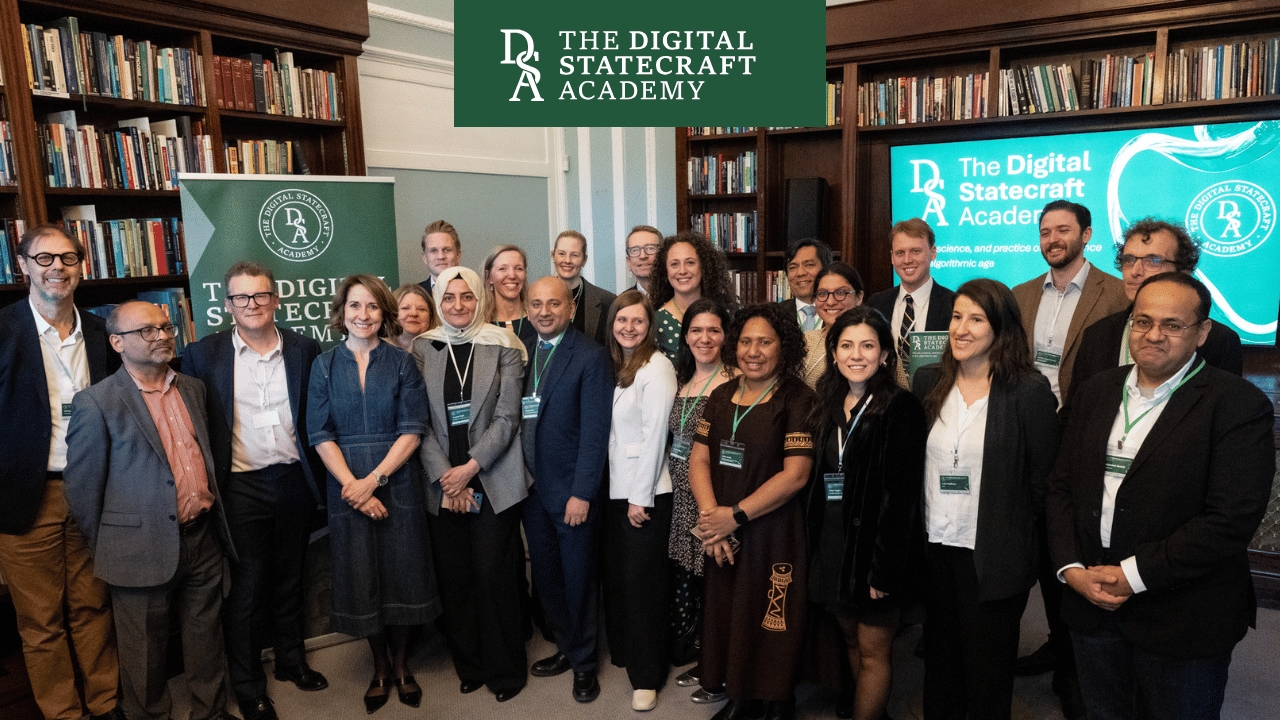
From 19–25 April 2026, The Digital Statecraft Academy (DSA) convened its inaugural Cambridge Fellowship cohort at Jesus College, University of Cambridge. Bringing together 16 Fellows from across the globe—from Papua New Guinea to Mexico, from Qatar to USA—the residency created a unique intellectual and collaborative environment for engaging with one of the defining challenges of our time: how to govern effectively in an era shaped by artificial intelligence, data, and digital infrastructure.
More than a programme, the week marked an important step in the emergence of digital statecraft as a field of practice—one that seeks to bridge technical innovation, policy design, and institutional capability.
From Concept to Practice
The residency was deliberately designed to move beyond abstract discussion toward applied, practice-oriented engagement. Fellows were not positioned as passive participants, but as active contributors—developing project-based work grounded in real institutional and policy challenges.
Across the week, sessions moved iteratively between conceptual framing, peer exchange, and practical application, enabling participants to define problems with greater precision, test assumptions, and refine solutions in dialogue with experts and one another .
This structure ensured that the programme produced not only insight, but also emerging frameworks and ideas with real-world relevance.
Digital Public Infrastructure as a Design Framework
One of the central intellectual pillars of the residency was Digital Public Infrastructure (DPI).
Rather than being treated solely as a technical construct, DPI was explored as a model for designing inclusive, interoperable, and scalable governance systems. Fellows engaged with its foundational components—identity systems, data exchange layers, payments infrastructure, and trust frameworks—alongside the architectural principles that underpin them, including interoperability, minimalism, and privacy by design .
Through comparative case studies from India, Estonia, and Brazil, participants examined how these systems function in practice. Crucially, they were then asked to translate these insights into their own institutional contexts through the design of “+1” interventions—small, targeted improvements that align existing systems with DPI principles.
In this sense, DPI emerged not simply as infrastructure, but as a methodology for institutional transformation.
Reframing Data for Policy
A second key pillar of the programme was the reframing of data as a strategic instrument of governance.
Sessions challenged the prevailing tendency to begin with available datasets, instead emphasising the importance of starting with clearly defined policy questions. By adopting a demand-driven approach, Fellows explored how data can be aligned with decision-making processes, ensuring that analysis is both relevant and actionable .
This perspective was further extended through discussions on data collaboratives, which highlighted the growing need for governance models that enable responsible data sharing across sectors. In an increasingly complex data landscape, such approaches are essential for unlocking data held outside government while maintaining trust, legitimacy, and accountability.
Governing AI in Practice
The governance of artificial intelligence formed another central axis of the residency, with discussions moving beyond principles to focus on implementation and institutional realities.
Fellows engaged with comparative regulatory approaches, including the European model, while also examining how organisations can assess, deploy, and oversee AI systems in high-stakes contexts. Workshops on risk classification and evaluation emphasised the importance of developing operational governance frameworks that can respond to rapidly evolving technologies.
Particular attention was given to the rise of large language models (LLMs) in policymaking. These systems, while offering new possibilities for evidence generation and analysis, also raise fundamental questions about reliability, bias, and accountability. The discussions underscored the need for robust institutional safeguards and human oversight in their use.
Engaging with Systems of Innovation
The residency was further enriched by direct engagement with institutions at the forefront of AI research and application.
At Microsoft Research Cambridge, Fellows engaged with Dr Abigail Sellen and Dr Kenji Takeda, exploring how AI systems are developed and translated into real-world applications. Discussions focused on human-centric AI, trust, and provenance, particularly in the context of generative AI, before concluding with a guided tour of the MSR laboratories .
This was complemented by a visit to the Alan Turing Institute, where Fellows engaged with experts including Dr Scott Hosking, Dr James Geddes, and Dr Chris Burr. Conversations explored applications of AI in areas such as environmental forecasting, alongside the development of assurance frameworks for trustworthy AI systems.
Together, these engagements reinforced a central premise: that effective digital statecraft depends on continuous interaction between technological development and institutional governance.
The DSA Launch Reception at the British Academy
A defining moment of the week was the DSA Launch Reception at the British Academy on 23 April.
The event brought together Fellows, advisors, and distinguished guests from across academia, government, industry, and the non-profit sector. Speakers included Rt Hon Liz Kendall MP, Hetan Shah – Chief Executive of the British Academy, and DSA co-founders Tim Gordon and Dr Zeynep Engin, who reflected on the need to build digital statecraft as a field that is both rigorous and practice-oriented.
The reception built on two key foundations: the publication of the DSA Founding Manifesto and the introduction of the inaugural Fellowship cohort.
As described by Rt Hon Liz Kendall MP, the DSA represents “an important and timely initiative” in responding to the challenges of governing in a rapidly evolving technological landscape.
An Active State in a Transformative Era
In her keynote, Rt Hon Liz Kendall MP also emphasised the need for governments to take an active role in shaping technological change:
“In Britain, we are determined that this government will not be a bystander. We have an active state, that is prepared to do things differently.”
She framed technological transformation as both an opportunity and a responsibility:
“Our mission is to help people through the changes technology inevitably brings, and shape a future that works for all, not just a few at the top.”
Highlighting the global dimension of governance, she noted:
“Working with other countries does not diminish our sovereignty, it strengthens it.”
And reflecting on the scale of change ahead:
“We are on the cusp of great change: an Industrial Revolution in a decade.”
These remarks resonated strongly with the aims of the DSA, reinforcing the need for governance approaches that are both forward-looking and grounded in public value.
From Residency to Community
Beyond its formal sessions, the residency fostered the emergence of a community of practice.
The diversity of the cohort—spanning geographies, disciplines, and institutional contexts—enabled a rich exchange of perspectives. Through sustained collaboration, Fellows developed shared frameworks and established relationships that will continue beyond the programme itself.
Looking Ahead
The DSA Cambridge residency marks the beginning of an ongoing effort to build digital statecraft as a field that is at once analytical and applied, grounded in both intellectual rigor and institutional relevance.
As Fellows continue their work across different contexts, the DSA’s mission remains clear: to ensure that the systems shaping our digital future are governed in ways that are effective, accountable, and aligned with the public good.